Worried that AI tools might cost you ownership of your art? Digital art copyright in the US protects the human-made parts of your work. As of the Copyright Office’s January 2025 report, prompts alone don’t qualify.
This guide sits within the site’s coverage of digital art.
| Item | Value |
|---|---|
| US Copyright Office report on AI and human contribution | Released January 2025 |
| Public comments the Office considered | More than 10,000 comments |
| Share of those comments about copyright claims | Around half |
| Place of this report in the Office’s AI series | Second of three parts |
| Work with no human involvement rejected | February 2022 |
| Comic book with AI images granted copyright | 2023 |
The figures come from Designboom and DeepLearning.AI. They can change, so check the sources before you rely on them.
What does digital art copyright cover when AI is involved?
The short answer from the US Copyright Office is that human authorship decides everything. The Office’s position, reported by Euronews, is that material generated wholly by AI is not copyrightable.
That view was shared by most of the more than 10,000 comments the Office considered, Designboom reports. The same report covers US copyright law only, so rules in other countries may differ.
In practice, the report sorts AI-related work into three buckets:
- Fully AI-generated work: not protected, because no human determined the expressive elements.
- Prompt-only work: also excluded, according to Designboom’s summary of the report.
- AI as an assistant: protected where your own contribution is present, even if you used tools such as Midjourney and DALL-E.
What the January 2025 report actually says
As of the Copyright Office’s January 2025 report, the document is the second part of a three-part series on AI, Euronews explains. Register of Copyrights Shira Perlmutter said that where creativity is expressed through AI systems, “it continues to enjoy protection”.
The report does not call for new legislation. DeepLearning.AI notes that the Office judged existing laws sufficient to decide whether an AI-generated work is protected.
Outcomes are decided case by case. Designboom says it is a case-by-case basis to determine whether human contributions are sufficient to constitute authorship, and the Office deliberately avoided fixed criteria.
The same DeepLearning.AI piece cites two past decisions: a February 2022 rejection of a work with no human involvement, and a 2023 grant for a comic book that used AI-generated images. The comic qualified because a human created original elements such as text, arrangement and modifications.
Selection, coordination and modification: where your authorship counts
According to DeepLearning.AI, the report names three ways a human can contribute creative authorship to AI output:
- Selection: curating AI-generated elements.
- Coordination: organizing multiple generated outputs into a cohesive work.
- Modification: altering generated material in a way that makes it original.
Euronews adds that an AI-assisted work could be copyrightable if an artist’s handiwork is perceptible. A human adapting an AI output with creative arrangements or modifications could also fall under protection.
The Office compares this to earlier technology. The report argues its approach aligns with photography: protection depends on identifiable human creative input, even when a tool helps produce it.
Designboom adds a warning. Once you build generated material into your work, you must be able to prove that you created parts of it yourself to secure copyright and authorship.
Habits that make your human contribution easier to show
The report does not prescribe a paper trail, so treat the steps below as sensible editorial advice rather than legal requirements. The idea is to make your creative choices visible if anyone ever questions them.
- Keep layered working files and early sketches, not only the flattened final image.
- Save versions that show your edits, paint-overs and compositing decisions.
- Note which elements you drew or wrote yourself and which came from a generator.
- Keep prompt-only outputs separate from work you shaped by hand.
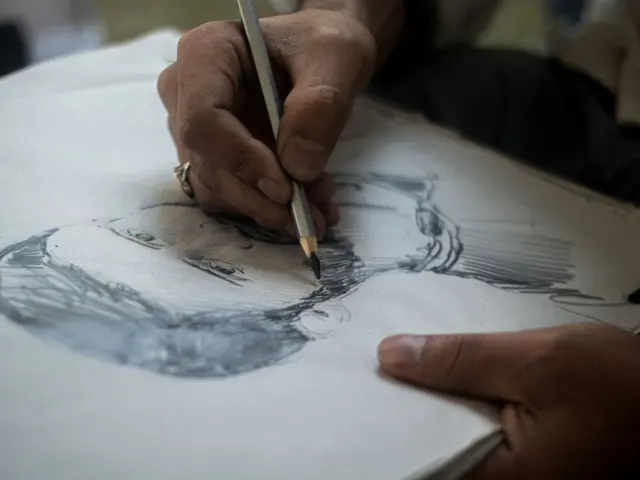
Hand-drawn linework is the kind of perceptible contribution the Office describes, and a good tablet helps you make it. If you are still choosing hardware, see the best drawing tablets for digital art.
Ownership also shapes what you can sell. When you are ready to put work in front of clients, read how to price digital art commissions for the money side of the question.
What the report leaves open
The report does not settle whether AI companies may train on your work. Euronews says the Office is working on another report that will turn to the training of AI models on copyrighted works, licensing considerations, and allocation of any liability.
As of Euronews’ January 2025 coverage, visual artists, authors and news organizations had sued AI companies in cases still working through US courts. The Office does not weigh in on those cases.
Likeness is a separate issue. The first part of the Office’s series found that existing laws don’t provide sufficient protection against unauthorized digital replicas, and it recommended federal legislation. As of DeepLearning.AI‘s March 2025 piece, no federal law defined whether copyright can protect a person’s likeness or performance.
The Office also says it will keep monitoring technological and legal developments and may revisit its conclusions. Check for newer guidance before you make decisions based on this page, and talk to a qualified attorney for advice on your own situation.
Frequently asked questions
Can I copyright art made with Midjourney or DALL-E?
Show answer
Possibly, in part. As of the Copyright Office’s January 2025 report, work made with such tools can be protected where a human determined sufficient expressive elements, and the protection covers the human-made parts.
Does a detailed prompt make me the author?
Show answer
According to the report as summarized by Euronews, simply prompting an AI image generator does not give you the ability to copyright the result. Your own selection, arrangement or modification is what counts.
Do I lose my copyright if AI touches up my own drawing?
Show answer
DeepLearning.AI reports that creators retain copyright even if AI processes their creative work. It adds that they lose it only if the generated output is genuinely transformative.
Does this apply outside the United States?
Show answer
The report covers US copyright law, so it should not be assumed to apply elsewhere. Check the rules in your own country.